

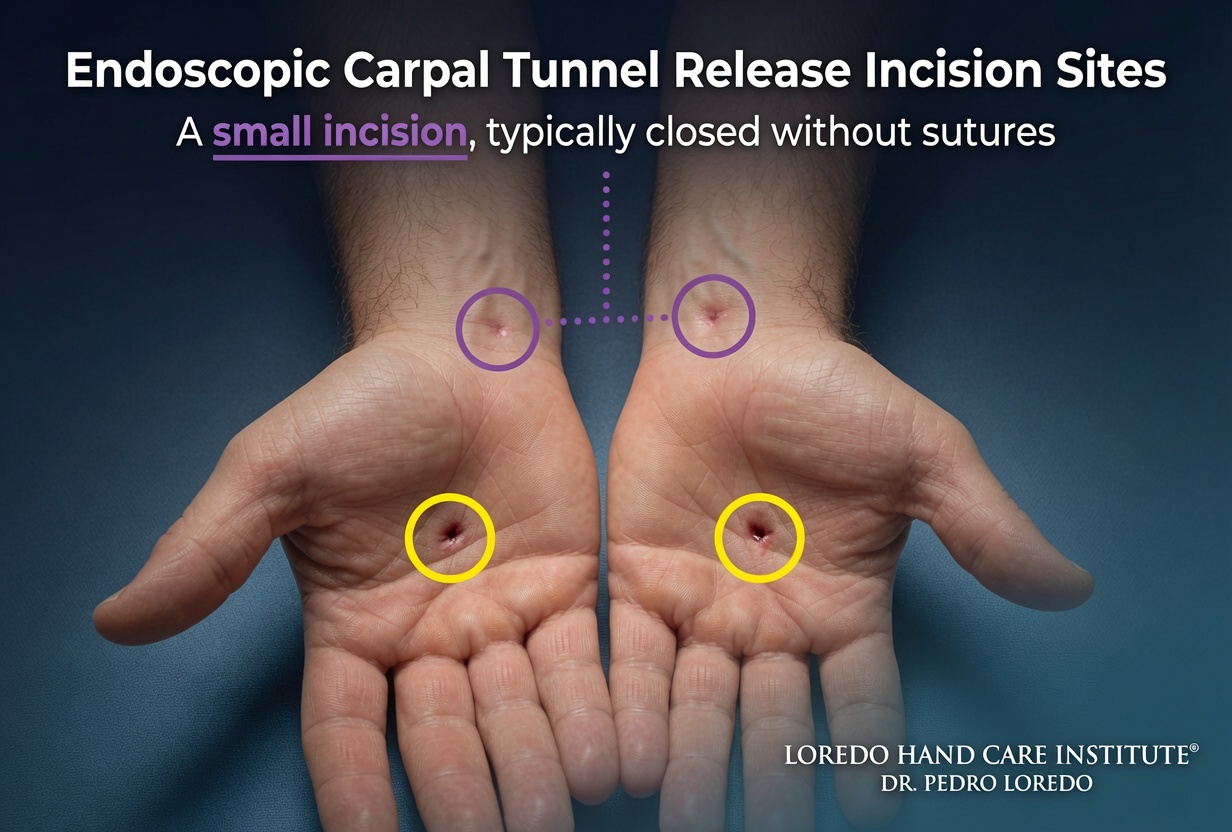
Endoscopic carpal tunnel release is the minimally invasive version of standard carpal tunnel surgery. Through a single micro incision at the wrist crease (smaller than a grain of rice), Dr. Loredo introduces a specialized endoscope that visualizes the transverse carpal ligament from below. The ligament is divided under direct view, immediately decompressing the median nerve. No skin sutures are required. The procedure takes 10 to 15 minutes under local anesthesia with light sedation. Most patients use the hand the same day, return to desk work within 2 to 7 days, and resume manual labor at 4 to 6 weeks.
What Is Endoscopic Carpal Tunnel Release?
The carpal tunnel is a narrow fibro-osseous passage at the base of the palm. Its floor is formed by the carpal bones, and its roof is the transverse carpal ligament, a thick band of fibrous tissue. Nine flexor tendons and the median nerve pass through the tunnel from the forearm into the hand. When pressure inside the tunnel rises (from fluid retention, ligament thickening, or external load), the median nerve is compressed and produces the characteristic numbness, tingling, and night symptoms of carpal tunnel syndrome.
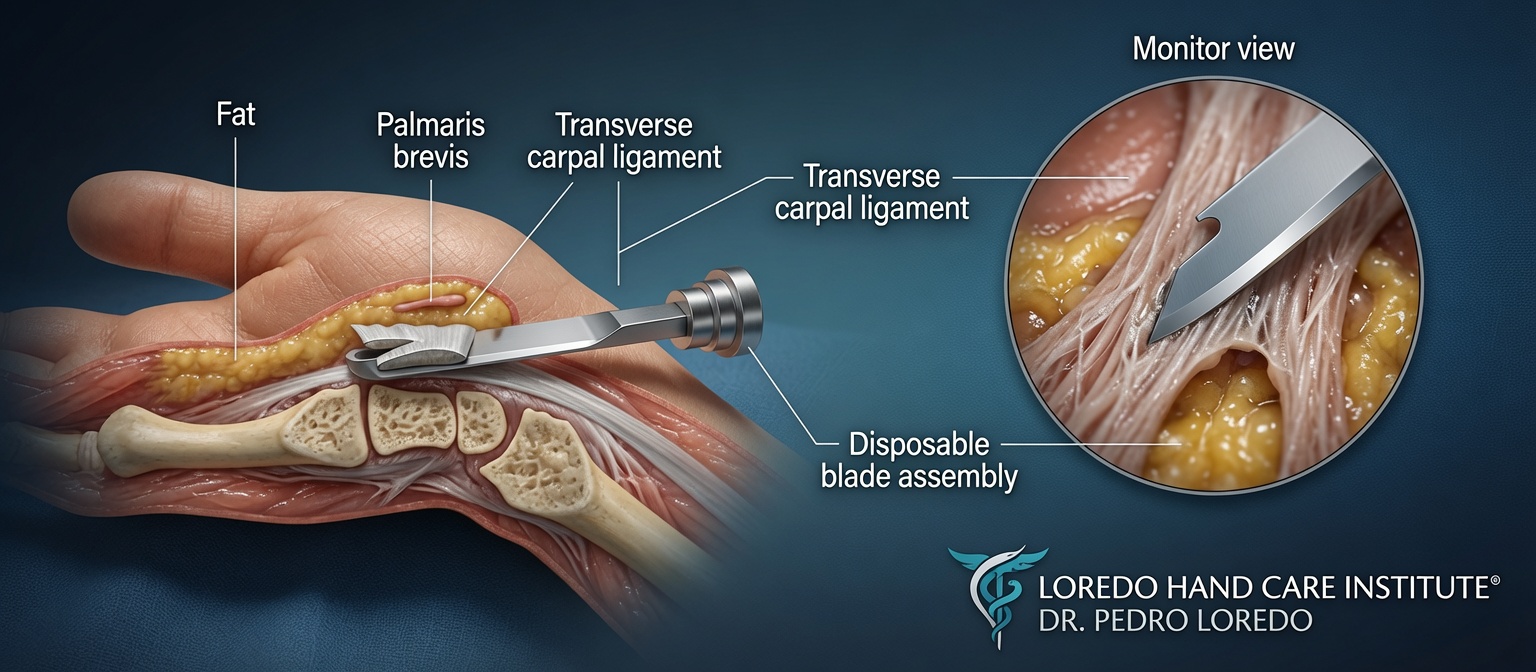
Surgical release divides the transverse carpal ligament, immediately reducing pressure inside the tunnel. The endoscopic approach accomplishes this division through a micro incision at the wrist rather than the larger palm incision used in open release. A specialized endoscope with a fiber-optic camera and an integrated cutting blade visualizes the ligament from inside the tunnel and divides it under direct view. The result is a complete release with a single small wound.

Who Is a Candidate?
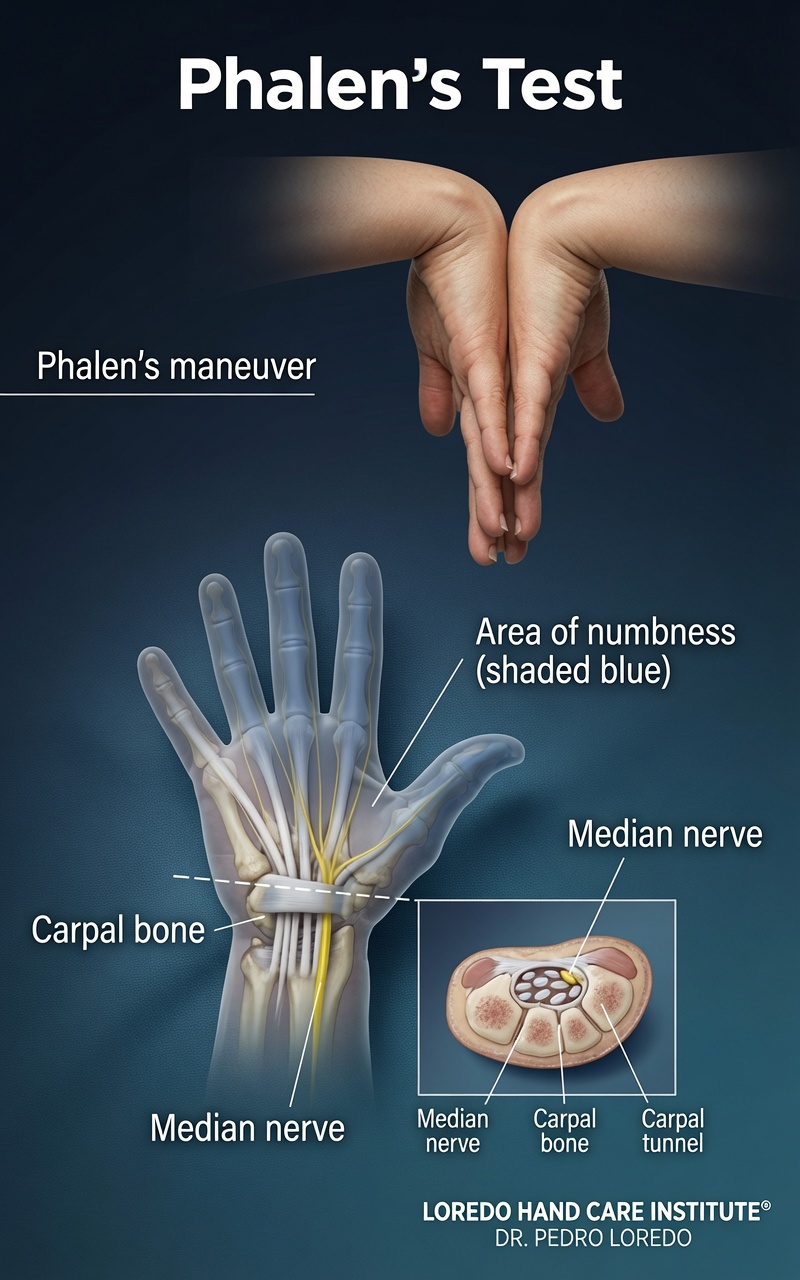
Endoscopic carpal tunnel release is appropriate for most patients with carpal tunnel syndrome who have failed conservative care. Specific indications include:
- Carpal tunnel syndrome confirmed by clinical examination, with positive Tinel, Phalen, or Durkan testing
- Electrodiagnostic studies (EMG and nerve conduction) confirming median nerve compression at the wrist
- Failure of 6 to 12 weeks of night splinting and activity modification
- Failure or limited benefit from corticosteroid injection
- Severe symptoms with night awakening, dropping objects, or visible thumb muscle atrophy that warrant prompt release
- Patient preference for minimally invasive surgery with rapid recovery
Open release may be preferred over endoscopic in patients with prior wrist surgery, anatomic variants demonstrated on imaging, certain revision cases, or strong patient preference for the open approach. Dr. Loredo discusses both options in detail at consultation. For full background on the underlying condition, see Carpal Tunnel Syndrome.
How the Procedure Is Performed
- Positioning and anesthesia. The patient lies on the operating table with the affected arm extended on a hand table. Local anesthetic is injected at the wrist; light sedation is given through an IV for comfort.
- Incision. A single micro incision (approximately 1 to 1.5 cm) is made at the wrist crease, just proximal to the transverse carpal ligament. The incision is hidden in the natural skin lines and heals with minimal visible scar.
- Endoscope introduction. A specialized endoscope with an integrated cutting blade is introduced into the carpal tunnel along the floor. The fiber-optic camera projects a magnified view of the underside of the transverse carpal ligament onto a video monitor.
- Ligament division. Under direct endoscopic visualization, the transverse carpal ligament is divided from distal to proximal. The cut is confirmed visually along the entire length of the ligament.
- Confirmation and closure. The endoscope is removed and the release is confirmed by direct palpation. The skin is closed with a buried absorbable suture or with adhesive strips. No skin sutures requiring removal are used.
- Dressing. A soft bulky dressing is applied for the first few days. No splint is required for the great majority of patients.

Anesthesia Options
- Local anesthesia with light sedation (most common): the wrist is numbed with local anesthetic. Light intravenous sedation (sometimes called twilight or MAC anesthesia) keeps you comfortable and relaxed but breathing on your own.
- Wide-awake local anesthesia (WALANT): local anesthetic with epinephrine and no sedation. Some patients prefer this approach because it eliminates the recovery period from sedation. Available on request.
- Regional Bier block: the entire arm is numbed below a tourniquet. Used in selected cases.
- General anesthesia is rarely needed for carpal tunnel release.
Procedure Duration and Setting
The actual surgical time is 10 to 15 minutes per hand. Total time at the surgery center is typically 1 to 2 hours including check-in, anesthesia, the procedure, and a brief recovery period. The procedure is performed at an accredited ambulatory surgery center (ASC) or at the office surgical suite, depending on insurance authorization and patient factors. Discharge is the same day. A family member or friend drives you home.
Recovery Timeline
- Day 0 (procedure day): Light hand use the same evening. Keep the dressing clean and dry. Elevate the hand above heart level when resting.
- Day 1 to 3: Routine daily activity at home. Most patients are off all pain medication by day 2.
- Week 1: Most patients return to desk work. First post-operative visit. The dressing is removed; no skin sutures to remove.
- Weeks 2 to 4: Grip strengthening exercises, tendon and nerve gliding. Pillar pain (mild soreness at the base of the palm) may be present and is expected.
- Weeks 4 to 6: Return to heavier activity, including manual labor and athletics, as tolerated.
- Months 2 to 6: Continued grip strength improvement. Nerve recovery progresses over months in severe pre-operative cases. Scar softens and flattens.
Return to Work and Daily Activities
- Office or desk work: 2 to 7 days for most patients
- Light manual labor: 1 to 3 weeks with activity modification
- Heavy manual labor and gripping: 4 to 6 weeks, often through a brief light-duty period
- Driving: 1 to 7 days, once off pain medication and able to grip the wheel comfortably
- Exercise: light cardio and lower body in week 1; upper body resistance training after week 4
Why Endoscopic Matters
The minimally invasive endoscopic approach offers several advantages over traditional open release:
- Single micro incision at the wrist, much smaller than the open palm incision
- No skin sutures to remove; closure is with absorbable suture or adhesive strips
- Preservation of the palmar fat pad that open release disrupts; this reduces pillar pain in the early recovery
- Direct endoscopic visualization of the entire transverse carpal ligament for a complete and safe release
- Faster return to function: light hand use the same day, desk work in 2 to 7 days
- Lower scar-related discomfort with the small wrist incision compared to a palmar scar
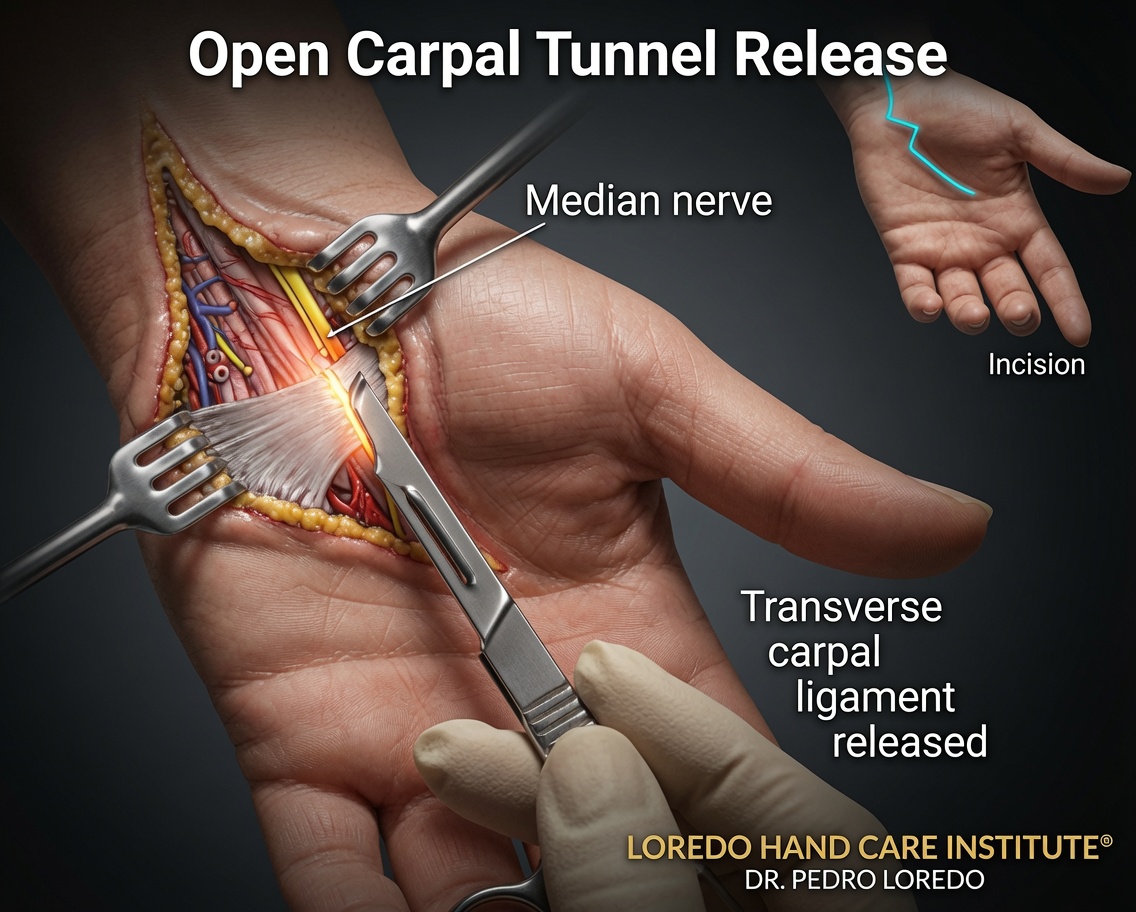
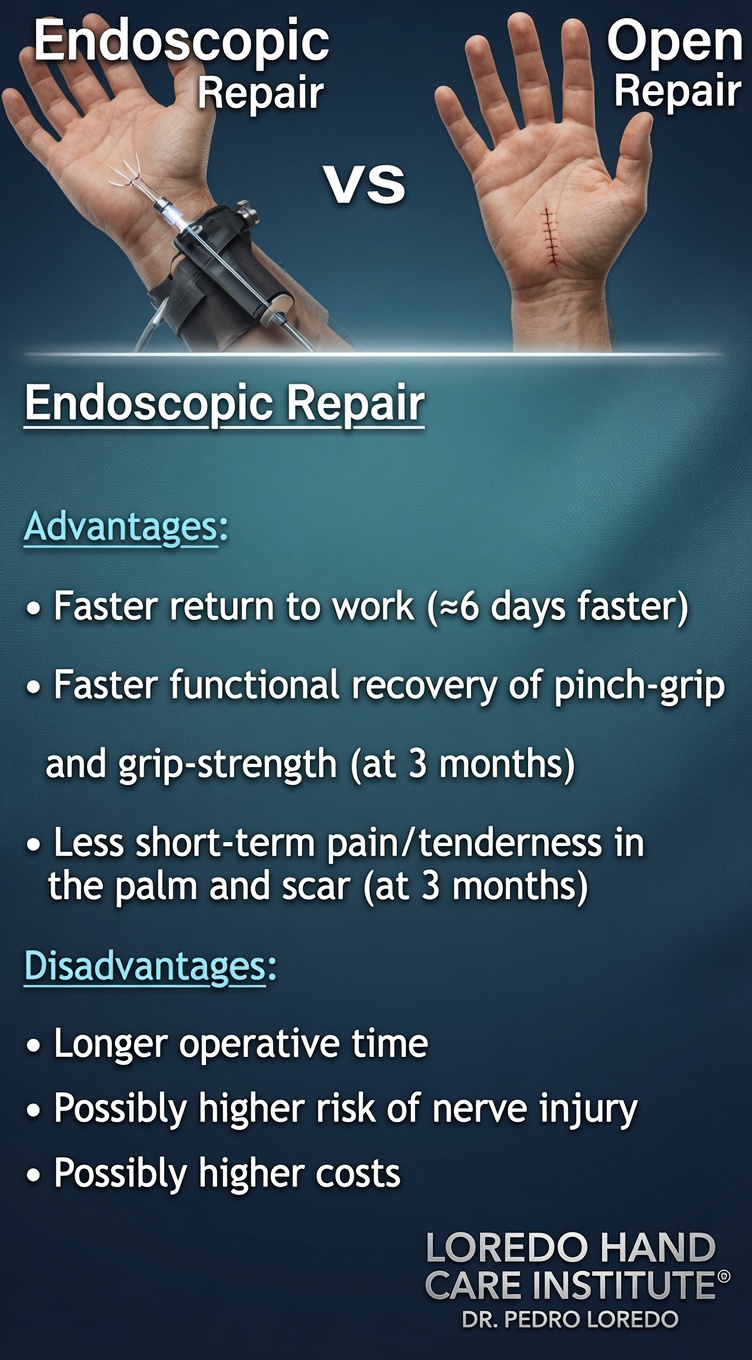
Long-term symptom relief is comparable between endoscopic and open release. The differences are concentrated in the early recovery period and in cosmetic outcomes.
Risks and Complications
Endoscopic carpal tunnel release is one of the safest hand operations performed. Complications are uncommon when performed by an experienced fellowship-trained hand surgeon, but the patient should know the recognized risks:
- Incomplete release (rare): the ligament is partially divided. Symptoms persist or recur. Revision surgery may be needed.
- Median nerve injury (very rare): direct injury during release. Risk is reduced by direct endoscopic visualization.
- Vascular injury (very rare): injury to the superficial palmar arch.
- Infection (less than 1 percent): treated with antibiotics; rarely requires reoperation.
- Pillar pain: transient soreness at the base of the palm in the first few weeks. Expected and resolves with time.
- Scar tenderness at the wrist incision; uncommon and resolves over weeks to months.
- Persistent or recurrent symptoms: most often related to severe pre-operative nerve compression with incomplete recovery, not to incomplete surgery. Severe long-standing cases may have permanent residual numbness even after a successful release.
- Anesthesia-related risks: rare with light sedation.
Cost and Insurance
Endoscopic carpal tunnel release (CPT 29848) is covered by virtually all commercial insurance plans, Medicare, the VA Community Care Network under the MISSION Act, and Texas workers' compensation when the diagnosis is appropriately documented. The total cost includes the surgeon fee, the surgery center facility fee, and the anesthesia fee. Out-of-pocket cost depends on your specific plan, deductible, copay, and out-of-network status if applicable.
Our team verifies your benefits before surgery and provides a clear estimate of expected cost. CareCredit and other financing options are available when out-of-pocket cost warrants. Call our office at (972) 939-4974 for a benefits check before your visit.
Frequently Asked Questions
How is endoscopic carpal tunnel release different from open release?
Open carpal tunnel release uses a 2 to 3 cm incision in the palm and divides the transverse carpal ligament under direct view. Endoscopic release uses a single micro incision at the wrist crease and divides the same ligament from the inside under endoscopic visualization. Both procedures release the median nerve completely. The endoscopic approach preserves the palmar fat pad, requires no skin sutures, and allows most patients to return to light function the same day. Pillar pain (a common complaint after open release) is reduced. Long-term symptom relief is comparable between the two approaches.
How long does the procedure take?
The actual surgical time is 10 to 15 minutes per hand. Add about 30 to 45 minutes for check-in, anesthesia, dressing, and a brief recovery before discharge. Patients typically arrive 60 to 90 minutes before the scheduled surgery time and leave the surgery center 1 to 2 hours after arrival.
Will I be asleep for the surgery?
Most patients receive local anesthesia at the wrist plus light intravenous sedation (sometimes called twilight or MAC anesthesia). You will be relaxed and comfortable but breathing on your own. General anesthesia is rarely needed for carpal tunnel release. Some patients prefer wide-awake local anesthesia (WALANT) without sedation, which is also offered at our practice.
When can I drive and return to work?
Most patients drive within 1 to 7 days after endoscopic release, once they are off any pain medication and can grip the steering wheel comfortably. Office or desk work resumes 2 to 7 days after surgery for most patients. Manual labor and heavy gripping return at 4 to 6 weeks, often through a brief period of light duty. Driving and return-to-work timing after open release is typically 1 to 2 weeks longer.
What does this cost and is it covered by insurance?
Endoscopic carpal tunnel release is covered by virtually all commercial insurance plans, Medicare, the VA Community Care Network under the MISSION Act, and Texas workers' compensation when the diagnosis is appropriately documented. Out-of-pocket cost depends on your specific plan, deductible, and copay. Our team verifies your benefits before surgery and provides a clear estimate of expected cost. Call our office at (972) 939-4974 for a benefits check.
Related Conditions
- Carpal Tunnel Syndrome: the underlying condition this procedure treats. Full diagnosis, conservative care, and pre-operative evaluation.
- Cubital Tunnel Syndrome: ulnar nerve compression at the elbow. Frequently coexists with carpal tunnel syndrome (double crush).
- Pronator Teres Syndrome: median nerve compression in the forearm, sometimes mistaken for or coexisting with carpal tunnel.
- Pregnancy Hand Pain: pregnancy carpal tunnel that does not resolve postpartum may need surgical release.
- Workers' Compensation Injuries: occupationally related carpal tunnel under Texas WC.
Related Procedures
- Endoscopic Cubital Tunnel Release: the elbow counterpart, often performed in the same operative setting when both nerves are compressed.
- Open A1 Pulley Release for Trigger Finger: another office-based hand procedure commonly performed in patients with diabetes or rheumatoid arthritis who also have carpal tunnel syndrome.
- De Quervain's Release: another wrist-area decompression, occasionally combined with carpal tunnel release in pregnancy or postpartum patients.
- All Procedures: the full list of surgical procedures offered at the practice.
From the Blog
- What to Expect After Carpal Tunnel Surgery: week-by-week recovery.
- What Minimally Invasive Really Means: single-port versus two-port and when each is appropriate.
- Night Splints for Carpal Tunnel: conservative treatment before surgery.
Watch: Endoscopic carpal tunnel release education
Short videos from Dr. Loredo's YouTube and Facebook channels.