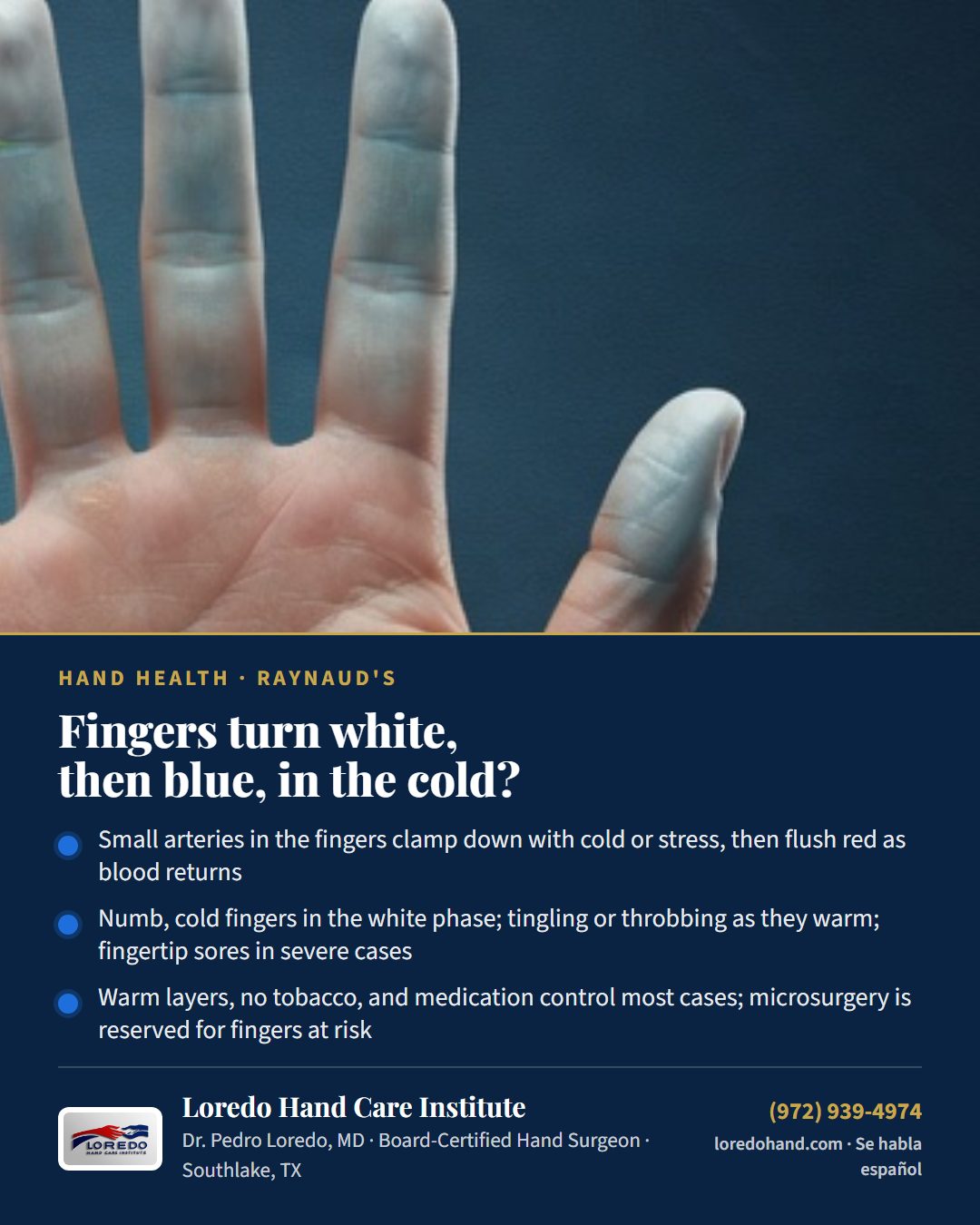
Raynaud's is a spasm of the small arteries that feed the fingers. Cold or emotional stress makes them clamp down, so the fingers blanch white, turn blue as the oxygen runs low, then flush red and throb as blood returns. Most people have the primary form, which is uncomfortable but not dangerous. A smaller group has Raynaud's as part of another condition, which is why new or worsening attacks deserve a look.
Warning signs
- Fingers that go white, then blue, then red with cold or stress
- Cold, numb fingers during an attack and tingling or burning as they warm
- Attacks that start affecting the thumb, or only one hand
- Sores or pitted scars at the fingertips, which need prompt attention
Treatment
Keeping the whole body warm, layered gloves, and stopping all tobacco are the foundation. Daily medication that relaxes the small arteries controls most cases. For patients with fingertip ulcers or tissue at risk despite medication, a microsurgical procedure that strips the nerve fibers driving the spasm from the finger arteries can restore blood flow.
Find this post on: Facebook Instagram YouTube LinkedIn
Questions patients ask
What is raynaud's?
Raynaud's is a spasm of the small arteries that feed the fingers. Cold or emotional stress makes them clamp down, so the fingers blanch white, turn blue as the oxygen runs low, then flush red and throb as blood returns. Most people have the primary form, which is uncomfortable but not dangerous. A smaller group has Raynaud's as part of another condition, which is why new or worsening attacks deserve a look.
What are the warning signs of raynaud's?
Fingers that go white, then blue, then red with cold or stress. Cold, numb fingers during an attack and tingling or burning as they warm. Attacks that start affecting the thumb, or only one hand. Sores or pitted scars at the fingertips, which need prompt attention.
How is raynaud's treated?
Keeping the whole body warm, layered gloves, and stopping all tobacco are the foundation. Daily medication that relaxes the small arteries controls most cases. For patients with fingertip ulcers or tissue at risk despite medication, a microsurgical procedure that strips the nerve fibers driving the spasm from the finger arteries can restore blood flow.
Who treats raynaud's near Southlake and Dallas-Fort Worth?
Dr. Pedro Loredo, a board-certified hand surgeon (General Surgery, American Board of Surgery; Hand Surgery, American Board of Plastic Surgery) at Loredo Hand Care Institute, 431 E State Hwy 114, Suite 380, Southlake, TX. New patients are seen within days. Call (972) 939-4974. Se habla español.
En español: ¿Los dedos se ponen blancos y luego azules con el frío?
El fenómeno de Raynaud es un espasmo de las arterias pequeñas que alimentan los dedos. El frío o el estrés hacen que se cierren, así que los dedos se ponen blancos, luego azules al faltar oxígeno y después rojos y palpitantes cuando vuelve la sangre. La mayoría tiene la forma primaria, incómoda pero no peligrosa. Un grupo menor lo tiene como parte de otra enfermedad, por eso los ataques nuevos o que empeoran merecen revisión.
Señales de alerta
- Dedos que se ponen blancos, luego azules y luego rojos con el frío o el estrés
- Dedos fríos y dormidos durante el ataque; hormigueo o ardor al calentarse
- Ataques que empiezan a afectar el pulgar o una sola mano
- Llagas o cicatrices hundidas en las puntas de los dedos, que requieren atención pronta
Tratamiento
Mantener caliente todo el cuerpo, guantes en capas y dejar por completo el tabaco son la base. Un medicamento diario que relaja las arterias pequeñas controla la mayoría de los casos. Para pacientes con úlceras en las puntas o tejido en riesgo a pesar del medicamento, una microcirugía que retira de las arterias del dedo las fibras nerviosas que provocan el espasmo puede restablecer el flujo de sangre.
If this sounds like your hand
Call Loredo Hand Care Institute or start your forms online. New patients are seen within days; surgery, when needed, is scheduled at the first available opening. Se habla español.