
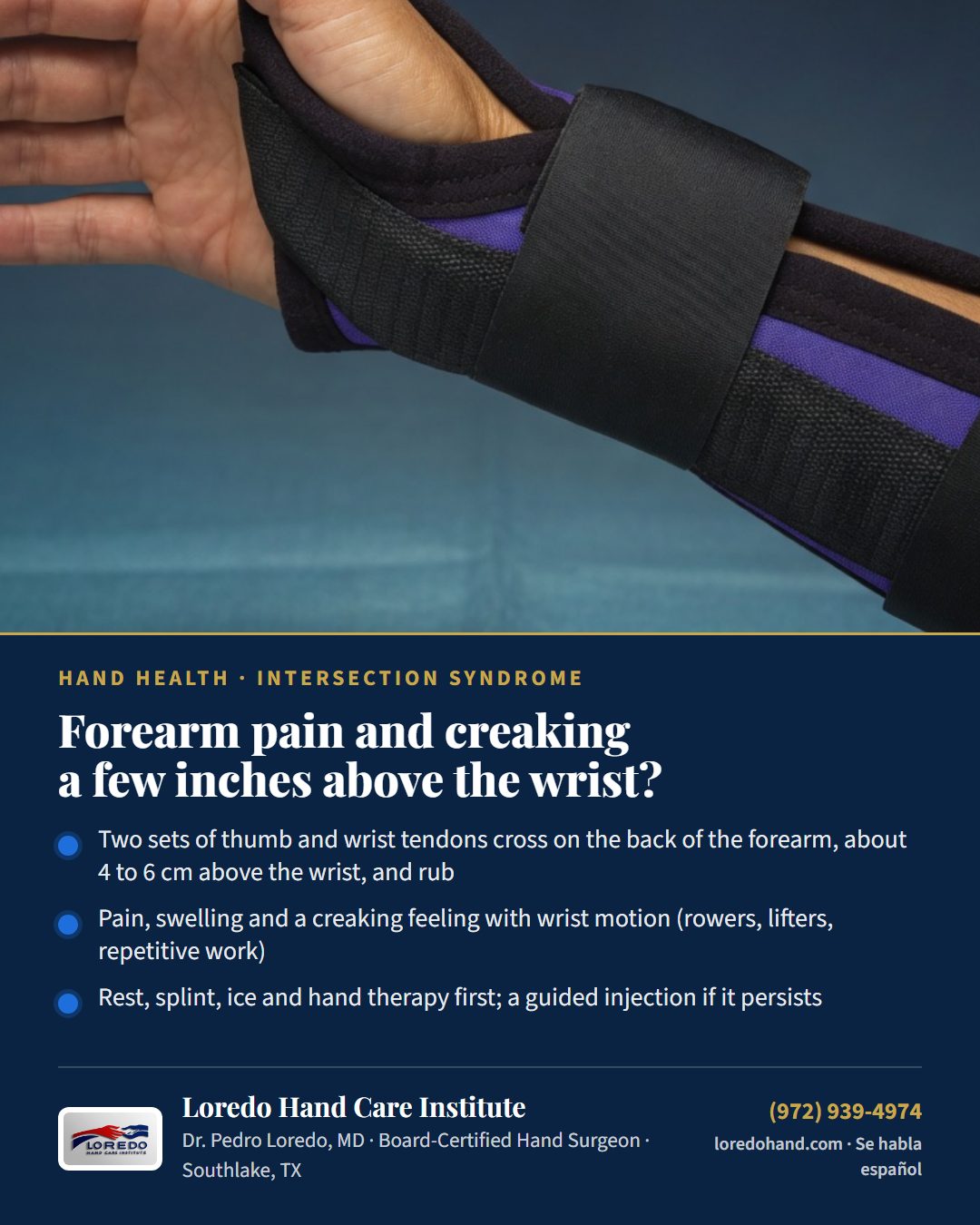
The tendons that move the thumb cross over the tendons that bend the wrist back. Repeated motion makes them rub and inflame where they cross.
Warning signs
- Pain and tenderness on the back of the forearm above the wrist
- Swelling along the tendons
- A creaking or crackling feeling (crepitus) with wrist motion
- Worse with the activity that started it: rowing, lifting, repetitive work
Treatment
Rest from the aggravating activity, a neutral wrist splint, ice, anti-inflammatory medication, and targeted hand therapy settle most cases. A corticosteroid injection under ultrasound guidance is used for moderate to severe symptoms. Surgery to decompress the compartment is reserved for the rare case that does not respond.
Find this post on: Facebook Instagram LinkedIn
Questions patients ask
What is intersection syndrome?
The tendons that move the thumb cross over the tendons that bend the wrist back. Repeated motion makes them rub and inflame where they cross.
What are the warning signs of intersection syndrome?
Pain and tenderness on the back of the forearm above the wrist. Swelling along the tendons. A creaking or crackling feeling (crepitus) with wrist motion. Worse with the activity that started it: rowing, lifting, repetitive work.
How is intersection syndrome treated?
Rest from the aggravating activity, a neutral wrist splint, ice, anti-inflammatory medication, and targeted hand therapy settle most cases. A corticosteroid injection under ultrasound guidance is used for moderate to severe symptoms. Surgery to decompress the compartment is reserved for the rare case that does not respond.
Who treats intersection syndrome near Southlake and Dallas-Fort Worth?
Dr. Pedro Loredo, a board-certified hand surgeon (General Surgery, American Board of Surgery; Hand Surgery, American Board of Plastic Surgery) at Loredo Hand Care Institute, 431 E State Hwy 114, Suite 380, Southlake, TX. New patients are seen within days. Call (972) 939-4974. Se habla español.
En español: ¿Dolor y crujido en el antebrazo, arriba de la muñeca?
Los tendones que mueven el pulgar cruzan sobre los tendones que extienden la muñeca. El movimiento repetido hace que se rocen y se inflamen en ese cruce.
Señales de alerta
- Dolor y sensibilidad en la parte de atrás del antebrazo, arriba de la muñeca
- Hinchazón a lo largo de los tendones
- Una sensación de crujido o rechinido al mover la muñeca
- Peor con la actividad que lo causó: remar, levantar peso, trabajo repetitivo
Tratamiento
Descanso de la actividad que lo agrava, férula de muñeca neutra, hielo, antiinflamatorios y terapia de mano resuelven la mayoría de los casos. Una inyección de corticoide guiada por ultrasonido se usa en casos moderados a severos. La cirugía se reserva para el raro caso que no responde.
If this sounds like your hand
Call Loredo Hand Care Institute or start your forms online. New patients are seen within days; surgery, when needed, is scheduled at the first available opening. Se habla español.